
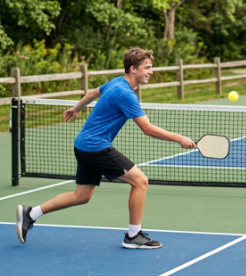
In order to get more “power,” players often grasp their paddles in a death grip and swing their arms as hard as they can.
Not only is this a futile attempt to generate more pace on the ball, but it actually decreases what players are actually trying to generate—more force.
This happens because tense muscles prevent the arm from accelerating optimally!
How can your players generate more pace with their shots with less effort and stress?
First, it’s important to use the right terminology. Players don’t necessarily want to hit the ball “hard” or with more “power,” they want to hit the ball with more “force.”
Why is this important to know? Because we can easily define “Force:” It’s “Mass X Acceleration“—and this lets us figure out how to hit the ball better.
As far as “Mass” goes, that’s the size of the ball and paddle—not much you can do there.
In terms of “acceleration,” ask your players if they would rather hit the ball with a paddle that’s traveling 100 mph, or one that’s only moving at 60 mph. Now, they’ll get the point, and want to know how to accelerate their paddles.
The key to accelerating a tennis paddle is to use the
larger muscles groups. This means that on the serve, backhand, forehand, overhead and even the volley, players want to primarily use the portions of their bodies from the knees and the shoulders.
Make sure your players understand why they need to bend their knees during their shots. It’s because they can then push off the ground and create more paddle acceleration. It’s not the knee bend that helps—it’s the pushing back up!
An old teaching technique to help players understand the role of the legs on groundstrokes is to have students sit in a chair, then quickly get up and out of the chair to hit a fed ball.
Each time they do this, they feel the muscles in their legs working much harder than normal.
This is where the famous golf mantra “Swing Easy, Hit
Hard” gets its truth. If your players relax their grips and think of swinging fast, rather than hard, they’ll actually accelerate the paddle faster.
An upward leg motion also creates more paddle speed, which results in increased spin, as well. Spin doesn’t come from excessive wrist movement—it comes primarily from a paddle traveling upward.
More acceleration = more spin.
Your players should not try this for the first time in a match, because timing the push off the ground with the paddle swing is a skill which requires the development of the correct timing.
Keeping low on shots, especially the return, also gives players a lower center of gravity and better body balance.
For a whole host of reasons, having your players get down, then back up, will improve their shots by increasing their “power” and spin—and with less effort!